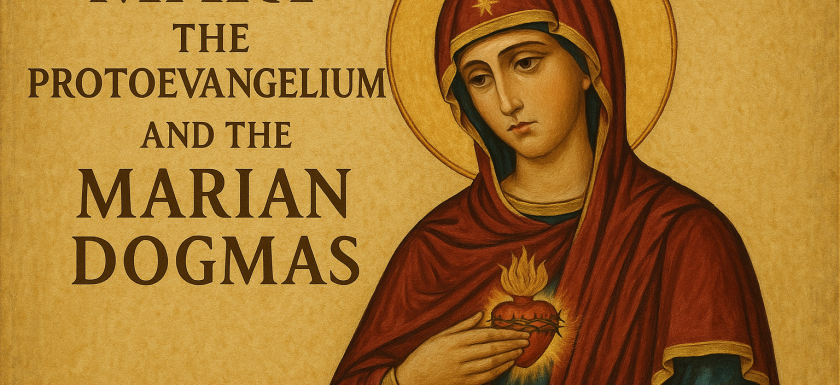
The Protoevangelium of James is the earliest surviving written source for several beliefs about Mary that later became Roman Catholic dogma or devotion. When we trace those beliefs back, we find a second-century legend, not the apostles’ writings.
What the Protoevangelium says about Mary
Quotations are from the Alexander Walker translation, *Ante-Nicene Fathers*, Vol. 8 (1886).
– Her miraculous birth. An angel announces it to her childless mother:
> “Anna, Anna, the Lord has heard your prayer, and you shall conceive, and shall bring forth.” (ch. 4)
– Her childhood in the Temple. At age three she is presented at the Temple and lives there:
> “Mary was in the temple of the Lord as if she were a dove that dwelt there, and she received food from the hand of an angel.” (ch. 8)
– Joseph as an elderly widower. He is chosen by a miraculous sign, a dove flying out of his rod, and protests:
> “I have children, and I am an old man, and she is a young girl.” (ch. 9)
– Jesus’ “brothers” as Joseph’s sons from an earlier marriage. On the way to Bethlehem Joseph says, “I shall enrol my sons” (ch. 17).
– Her virginity during and after childbirth. The midwife announces:
> “A virgin has brought forth — a thing which her nature admits not of.” (ch. 19)
A woman named Salome refuses to believe it until she physically examines Mary, and her hand is struck “as if burned with fire” (ch. 20).
– A false claim of authorship. The book closes by claiming to be written by James in Jerusalem around the time Herod died (ch. 24). Scholars date it to about AD 150 or later.
Where these stories show up in Catholic teaching
– Perpetual virginity. The book is the earliest surviving assertion that Mary remained a virgin before, during, and after Jesus’ birth. Pope Innocent I condemned it in 405, and the Gelasian Decree classified it as apocryphal around 500. Even so, it became a widely influential source for Mariology.
– Feast days. The Catholic feast of St. Joachim and St. Anne (July 26) and the Presentation of Mary in the Temple (November 21) come straight from this book’s stories.
– Immaculate Conception (defined 1854). The Protoevangelium doesn’t teach this dogma. But its picture of a miraculously conceived, sinless-seeming Mary, raised in the Holy of Holies and fed by angels, set the stage for later development.
– The Assumption (defined 1950). This belief traces back to a different apocryphal tradition, the *Transitus Mariae* (“Passing of Mary”) writings from the 5th–6th centuries. The Gelasian Decree also lists those writings as apocryphal. It’s the same pattern from a different book.
Where it conflicts with Scripture
– Matthew 1:25. Joseph “did not know her till she had brought forth her firstborn Son.” In Scripture, “know” is the standard phrase for marital relations: “Adam knew Eve his wife, and she conceived” (Gen. 4:1). The natural reading is that the marriage was consummated after Jesus’ birth.
– A technical note: “firstborn” in Matthew 1:25 appears in the NKJV/KJV text but not in most modern translations. Luke 2:7 has “firstborn” in every translation, so the point stands either way.
– Jesus’ brothers and sisters. They are named: “James, Joses, Simon, and Judas,” along with “all His sisters” (Matt. 13:55–56). They appear alongside Mary as one household (Matt. 12:46–47; John 2:12; Acts 1:14). They did not believe in Him during His ministry (John 7:5). Paul calls James “the Lord’s brother” (Gal. 1:19).
– Two traditions that contradict each other.
– The Protoevangelium explains the brothers as Joseph’s sons from an earlier marriage. Jerome objected to exactly that, because it meant Joseph had been married before. The Western church instead preferred to read the brothers as cousins, so that both Joseph and Mary could be lifelong virgins.
– So the Eastern churches say “stepbrothers” and Rome says “cousins.” Both explanations exist to protect a belief that Scripture never states.
How a Catholic would argue
– “Until” doesn’t always imply a change afterward. Examples they cite include Michal having no child “to the day of her death” (2 Sam. 6:23) and Jesus’ promise to be with us “always, even to the end of the age” (Matt. 28:20).
– “Firstborn” is a legal title. It belonged to the child who opened the womb (Ex. 13:2), whether or not more children followed.
– “Brother” (adelphos) can mean a relative. Abram calls his nephew Lot “brethren” (Gen. 13:8).
– John 19:26–27. If Mary had other sons, why would Jesus entrust her to John?
– The dogma doesn’t rest on the Protoevangelium. They will say it rests on apostolic tradition, and the book is only one witness to it.
How we respond
– Matthew 1:25 is about marital relations. Joining “did not know her” with “until” naturally points to a change afterward. In 2 Samuel 6:23, death ended any possibility of change, which isn’t the case in Matthew.
– Greek had distinct words for “cousin” (*anepsios*, Col. 4:10) and “relative” (*syngenis*, Luke 1:36). The New Testament writers never use them for Jesus’ brothers.
– John 7:5 explains John 19: His brothers didn’t believe in Him yet. After the resurrection they did (Acts 1:14; 1 Cor. 15:7).
– If the belief really comes from the apostles, its earliest written witness shouldn’t be a pseudonymous legend that Rome’s own popes condemned.
– This is your main point. In practice the tradition decides in advance what Matthew 1:25 and “His brothers” are allowed to mean. Scripture is read through the tradition rather than the tradition being tested by Scripture (Acts 17:11).
Two notes for honesty
1. Rome rejected the book itself. Popes condemned the Protoevangelium, but they accepted some of the beliefs it popularized. Saying “Rome teaches the Protoevangelium” would be inaccurate. A fair way to put it: “the earliest written source for these beliefs is a book Rome itself rejected.”
2. The Reformers held perpetual virginity too.
– Luther, Zwingli, and many early Reformers believed Mary remained a virgin.
– Calvin argued that nothing could be proved either way from “until” in Matthew 1:25.
– Later Protestants largely moved away from the belief as they applied *Sola Scriptura* more consistently.
The test isn’t who held a belief, but whether Scripture teaches it.
Takeaway: Mary is “blessed among women” (Luke 1:42), and Scripture gives us all we need to honor her rightly. The beliefs that go beyond Scripture trace back to stories that the early church itself recognized as unreliable.
Sources:
– [The Protoevangelium of James (ANF Vol. 8, Walker translation) – New Advent](https://www.newadvent.org/fathers/0847.htm)
– [Gospel of James – Wikipedia](https://en.wikipedia.org/wiki/Gospel_of_James)
– [Saint Anne in Late Medieval Society – metseditions.org](https://metseditions.org/read/0NG22p4URgXu3EkhVZq1Hrg7Zevggd)