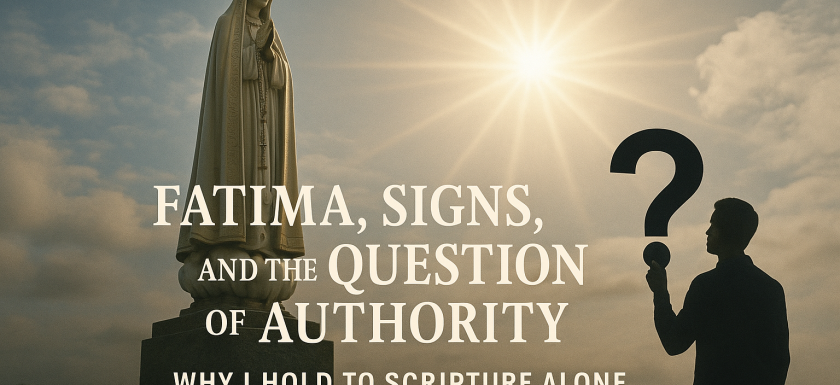
Every year on October 13, Roman Catholics around the world remember the final apparition of Our Lady of Fatima. It happened in 1917, in the fields outside a small village in Portugal. For many Catholics it is a treasured part of their faith. For me, as a Protestant, it raises a question that is worth asking calmly and honestly: when someone says they have received a message from heaven, how do we know whether it is true?
I want to describe what Rome teaches as fairly as I can, in its own words, and then explain from Scripture why I hold the position I do.
What Happened at Fatima
Between May and October 1917, three shepherd children said a heavenly Lady appeared to them on the 13th of each month. They were Lúcia dos Santos, age 10, and her cousins Francisco and Jacinta Marto, ages 9 and 7. On October 13, an estimated 50,000 to 70,000 people gathered in the rain. Only the children said they saw and heard the Lady. Many in the crowd reported that the sun appeared to spin and plunge toward the earth, an event now called the “Miracle of the Sun.” Others who were there saw nothing unusual.
According to Lúcia’s account, the Lady said:
> “I want to tell you that a chapel is to be built here in my honor. I am the Lady of the Rosary. Continue always to pray the Rosary every day.”
She also called people to amend their lives and stop offending God. In 1930 the local bishop declared the apparitions “worthy of belief,” and the Fatima shrine is now one of the most visited pilgrimage sites in the world.
The Rosary she asked for has five decades. It includes 6 Our Fathers, 6 Glory Be’s, and 53 Hail Marys addressed to Mary. Many Catholics also add the “Fatima Prayer” after each decade, a prayer Lúcia said was given during the July apparition.
The Real Difference: Where Does Authority Rest?
Underneath Fatima is a bigger question, the same one that divided the church in the sixteenth century.
Rome teaches that God’s revelation comes through Sacred Scripture and Sacred Tradition together, interpreted by the Church’s teaching office. The Catechism of the Catholic Church says the Church “does not derive her certainty about all revealed truths from the holy Scriptures alone. Both Scripture and Tradition must be accepted and honored with equal sentiments of devotion and reverence” (CCC 82).
To be fair, Rome does not put Fatima on the same level as the Bible. It calls Fatima a “private revelation,” and Catholics are not required to believe it. The Catechism even says such revelations are not meant “to improve or complete Christ’s definitive Revelation” (CCC 67). Rome also distinguishes between worship, which belongs to God alone, and veneration, which is the honor given to Mary and the saints. A Catholic would say that praying to Mary is like asking a friend to pray for you.
The Reformers confessed *Sola Scriptura*: Scripture alone is the only infallible rule of faith and practice for the church. Tradition, councils, and church teachers can be valuable, but they are fallible and must be tested by the Word of God. Paul tells Timothy that Scripture is “breathed out by God” and able to make the man of God “complete, equipped for every good work” (2 Timothy 3:16–17). Jude speaks of “the faith that was once for all delivered to the saints” (Jude 3).
So the question isn’t whether Catholics love Jesus. The question is which authority has the final word.
Testing What Claims to Come from Heaven
Scripture tells us plainly not to accept every spiritual experience at face value: “Beloved, do not believe every spirit, but test the spirits to see whether they are from God, for many false prophets have gone out into the world” (1 John 4:1). Paul says, “test everything; hold fast what is good” (1 Thessalonians 5:21). The Bereans were commended for “examining the Scriptures daily to see if these things were so” (Acts 17:11).
Scripture also warns that signs and wonders by themselves prove nothing. In Deuteronomy 13, God says that even if a prophet’s sign comes true, if the message leads His people toward worship He has not commanded, they must not listen. Jesus warned that “false Christs and false prophets will arise and perform great signs and wonders, so as to lead astray, if possible, even the elect” (Matthew 24:24). Paul writes that Satan “disguises himself as an angel of light” (2 Corinthians 11:14). He also says that even “an angel from heaven” preaching a different gospel should be rejected (Galatians 1:8).
When I hold the message of Fatima up to that standard, a few things stand out.
**God’s servants refuse honor for themselves.** When Cornelius fell at Peter’s feet, Peter said, “Stand up; I too am a man” (Acts 10:26). When the crowd at Lystra tried to honor Paul and Barnabas, they tore their clothes in protest (Acts 14:14–15). When John bowed before an angel, he was told, “You must not do that! I am a fellow servant with you… Worship God” (Revelation 19:10). No apostle, prophet, or saint in Scripture ever asked for a shrine in their own honor.
**The Mary of Scripture points to her Son.** Mary is rightly called blessed (Luke 1:48), and I honor her as the Bible does. Her own words were “My soul magnifies the Lord, and my spirit rejoices in God my Savior” (Luke 1:46–47). Her last recorded instruction to anyone was “Do whatever he tells you” (John 2:5). When a woman cried out a blessing on Jesus’ mother, Jesus answered, “Blessed rather are those who hear the word of God and keep it!” (Luke 11:27–28). The Mary of the Gospels points away from herself. The Lady of Fatima asks for a chapel in her own honor.
**We have one Mediator.** “There is one God, and there is one mediator between God and men, the man Christ Jesus” (1 Timothy 2:5). Jesus “always lives to make intercession” for us (Hebrews 7:25), and we are invited to “draw near to the throne of grace” with confidence (Hebrews 4:16). Jesus taught us to pray “Our Father in heaven.” Scripture shows believers on earth praying for one another, but it never shows or commands prayer to believers who have died.
**Jesus warned against empty repetition.** “When you pray, do not heap up empty phrases as the Gentiles do, for they think that they will be heard for their many words” (Matthew 6:7). Repetition isn’t wrong in itself, since Jesus prayed the same words three times in Gethsemane. The deeper concern with the Rosary is not how often the words are said. It is that most of its prayers are addressed to someone other than God.
Why I Hold This Position
If a heavenly visitor can introduce devotions the apostles never taught, then we lose any reliable way to tell true claims from false ones. Muhammad said the angel Gabriel gave him the Qur’an. Joseph Smith said the angel Moroni led him to the Book of Mormon. Fatima says the Virgin Mary asked for a chapel and the daily Rosary. Each claim came with sincere witnesses and remarkable experiences. Without a fixed standard, we’re left judging by feelings, crowds, and signs, and Jesus told us those can deceive.
Rome itself says private revelations cannot complete what Christ has revealed. I agree, and I believe that conclusion leads to Scripture as the final test. God “has spoken to us by his Son” (Hebrews 1:2), and that Word has been written down for us. I hold to Scripture alone not because tradition is worthless, and not because Catholics are insincere, but because God’s Word is the one place where I can know for certain what He has said.
If you’re a Catholic reading this, thank you for reading this far. My prayer is simply that all of us, whatever our tradition, would do what Mary herself told the servants at Cana: *”Do whatever he tells you.”*